
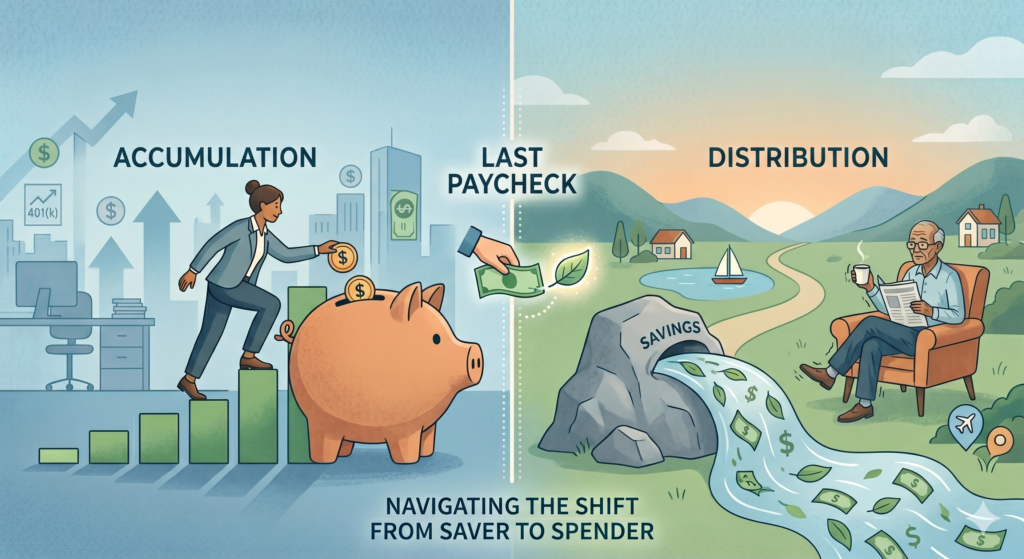
There’s a moment that happens for most people somewhere in the final weeks before retirement. You’ve done the math. You’ve talked to your advisor. The date is set. And then, quietly, it hits you: this is the last time a paycheck is just going to show up.
No more direct deposit. No more W-2. From here on, the money coming in is money you’ve already earned, saved, or planned for. That shift, from accumulating wealth to living off it, is one of the most significant financial transitions a person will make. And yet, for all the planning that goes into getting there, most people underestimate how much it changes everything, not just their finances, but how they think, feel, and make decisions about money.
This week on ABC13 NewsNow, Tim Fitzwilliams* joined the evening broadcast to talk through four of the most pressing questions people approaching retirement are asking right now. Here’s a deeper look at each one.
*This appearance is for informational purposes only and does not constitute an endorsement.
One of the Most Common Fears in Retirement Isn’t What Most People Expect
Ask a room full of retirees or people within five years of retirement what they’re most afraid of, and you’d expect answers like market crashes, health scares, or inflation. Those all come up. In many conversations with individuals approaching retirement, a common concern that comes up is: outliving their money.
The fear isn’t dying. The fear is running out.
This is sometimes called longevity risk, and it’s become more pressing with each passing decade. Life expectancy has increased significantly over the past generation. Based on general life expectancy trends, many individuals who reach age 65 may live into their late 80s or beyond. For couples, there’s an even higher likelihood that at least one spouse will live past 90. That’s potentially 25 to 30 years of retirement to fund.
What makes this fear so potent is that it’s not just about money. It’s about independence, dignity, and not becoming a burden on family members. People who spent their entire careers providing for others can’t bear the thought of needing to be provided for, especially if the reason is aretirement plan that ran dry.
The planning implication here is significant. A strategy built only to get someone to age 80 isn’t a retirement strategy. It’s a partial one. Any thoughtful retirement income plan may need to account for the realistic possibility of a long life, and that means the plan needs durability, not just adequacy.
How Do You Know If You’ve Saved Enough?
This is the question that brings most people into an advisor’s office in the first place, and it doesn’t have a one-size-fits-all answer. But there are frameworks that make it much less of a guessing game.
The foundational question isn’t “how much have I saved?” It’s “how much do I need my savings to produce each month, and for how long?”
Start with what the income picture actually looks like. If a hypothetical household has Social Security income of $3,200 per month and a pension of $800 per month, that’s $4,000 in
guaranteed monthly income. If their lifestyle requires $6,500 per month to maintain, then the gap is $2,500 per month that needs to come from their savings and investments.
That $2,500 per month is $30,000 per year. And if we’re planning for a 25-year retirement, we’re not just multiplying $30,000 by 25 and arriving at $750,000. We also have to account for inflation eroding purchasing power over time, the sequence of market returns (more on that below), healthcare cost increases that historically outpace general inflation, and unplanned expenses that tend to surface in retirement.
One commonly referenced rule of thumb, sometimes called the 4% guideline, suggests that a portfolio designed to last 30 years might reasonably support annual withdrawals of approximately 4% of its initial value. Under this framework, a $1 million portfolio could hypothetically support around $40,000 per year in withdrawals. This is a planning concept, not a guarantee, and outcomes will vary significantly based on market conditions, investment mix, spending patterns, and individual circumstances.
The honest answer to “have I saved enough” requires a personalized analysis that accounts for your specific income sources, your real expenses, your health picture, and your goals for how you want to spend your time. There’s no shortcut that replaces that conversation.
The Psychology of Spending Changes Completely at Retirement
This is something that doesn’t get discussed nearly enough in traditional financial planning conversations, and it catches a lot of retirees off guard.
During the accumulation years, the financial habit that gets rewarded is saving. Spend less, save more. Contribute to the 401(k). Reinvest dividends. The virtue is restraint. The goal is
growth. And for 30 or 40 years, that’s the muscle people develop.
Then retirement arrives, and suddenly the job is to spend the money you saved. And for a lot of people, that’s psychologically harder than it sounds.
It’s commonly observed that retirees, even those with more than sufficient assets, hesitate to spend from their portfolios. They watch the balance drop after taking a withdrawal and feel
anxiety, even when the withdrawal is entirely within the sustainable range of their plan. Some retirees underspend in early retirement out of fear, only to find themselves in their 80s with
significant assets they were never able to enjoy.
There’s also something that tends to happen in the other direction for people who haven’t fully internalized that their paycheck is gone. In the early months of retirement, before the new reality fully sets in, some retirees spend at a pace that isn’t sustainable. The freedom and novelty of retirement, travel, home projects, gifts to children and grandchildren, can create a spending surge that wasn’t fully accounted for in the plan.
Many retirees find that spending doesn’t follow a flat trajectory. Early retirement tends to be more active and more expensive. Middle retirement often sees spending stabilize as people
settle into routines. Later retirement typically brings higher healthcare costs but reduced discretionary spending. A plan that accounts for this curve is more realistic than one that assumes a fixed monthly draw for 25 years.
The mental shift required is real: from saver to spender, from accumulator to distributor. For many people, working through this shift is one of the most valuable parts of the retirement planning process.
Sequence of Returns: Why the Timing of Market Gains and Losses Matters More Than the Average
This concept is one of the most important, and most underappreciated, ideas in retirement income planning. And it’s also one of the clearest illustrations of why retirement investing is
fundamentally different from pre-retirement investing.
Here’s the core concept. If you’re still working and contributing to your portfolio, market volatility is largely your friend. A down market means you’re buying shares at a discount. A recovery brings those shares back up, and then some. The sequence of gains and losses matters less because you’re adding money, not taking it out.
Retirement changes that equation entirely.
When you’re withdrawing from a portfolio rather than contributing to it, the order in which returns occur has a dramatic effect on how long the money lasts. Specifically, a significant market decline in the early years of retirement, combined with ongoing withdrawals, can permanently impair a portfolio’s ability to recover, even if average returns over the full period look perfectly acceptable.
A simplified example illustrates the point. Imagine two hypothetical retirees, both starting with $1 million, both taking $50,000 per year in withdrawals, and both experiencing the exact same average annual return of 6% over 20 years. The only difference is the sequence. Retiree A experiences strong returns early, then poor returns late. Retiree B experiences poor returns
early, then strong returns late. Despite identical averages, Retiree B could potentially run out of money sooner, potentially by more than a decade, simply because the bad years happened while withdrawals were actively depleting the portfolio.
This is sequence of returns risk. And it’s not a theoretical concern. It’s a very real planning challenge for anyone retiring into or near a volatile market environment.
The practical responses to this risk are worth understanding. One approach involves building a buffer of more stable, lower-volatility assets that can fund withdrawals during down markets,
allowing equity positions time to recover without being sold at a loss. Another approach involves structuring income sources, including annuities or other guaranteed income tools when
appropriate, to reduce the portfolio’s reliance on market performance for covering essential expenses. Some strategies involve dynamic withdrawal approaches that flex with market
conditions rather than drawing a fixed dollar amount regardless of what the market is doing.
None of these are one-size-fits-all solutions. Each carries tradeoffs. But understanding sequence of returns risk, and planning around it, is an important distinction between a retirement strategy built for the real world and one built only for the best-case scenario.
Fitzwilliams Wealth Management, Inc. is an SEC registered investment advisor. Advisory services are offered only in states where properly registered or exempt. FWM and Fitzwilliams Financial are affiliated companies. The Adviser may only
transact business in states where it is properly registered or is excluded or exempted from registration requirements. Registration does not imply a certain level of skill or training. The information contained herein is for informational purposes
only and should not be construed as personalized investment advice, a solicitation, or an offer to buy or sell any security. Individualized investment advice can only be provided after entering into an advisory agreement. Fitzwilliams Wealth
Management, Inc. does not provide tax or legal advice. Please consult your tax and/or legal professional regarding your specific situation. Investing involves risk, including the potential loss of principal.